
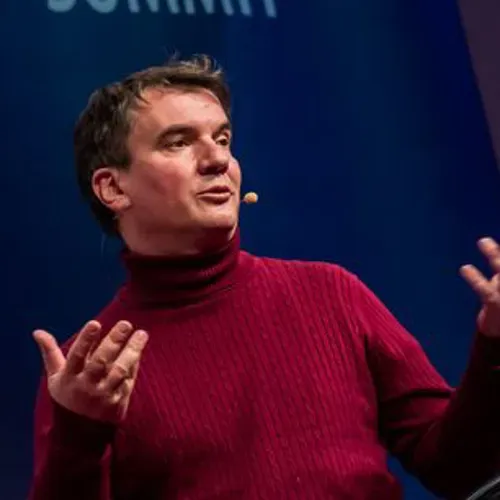
Among the highlights of the H2H Summit in Dubai on 15 January 2026 was a set of five principles for using AI in live experiences. They were summed up in a single line, and it is a line worth returning to nine months on: "AI cleans the path, humans walk it."
This piece does not restate the principles. It reads the line itself, because it gives AI and people different jobs instead of setting them against each other.
A division of labour, not a contest
On our reading, the path is everything that stands between a person's intention to attend and the experience they came for. The walk is the experience itself: the conversation, the discovery, the moment in a room that could not have happened online.
Read that way, the line follows directly from the idea at the heart of H2H. As the world becomes more digital, face-to-face experiences become more valuable, not less. The organisers call human connection "the ultimate currency". If that is true, technology's job is to clear the way so that more of it changes hands, not to mint a substitute. The same thread ran through the wider programme, from a keynote on the role of technology in human connection to roundtables on AI and human synergies.
The path: where AI earns its place
In our view, friction is rarely the reason anyone remembers an event, but it is often the reason they leave early or do not come back. The path covers the work that is necessary, repetitive and invisible when done well:
- Before arrival: registration, answering the same logistical questions again and again, helping people decide which sessions suit them.
- On the day: entry flows, wayfinding, queue information and timely updates when plans change.
- Behind the scenes: scheduling, translation, content tagging and the first draft of a follow-up.
- Afterwards: making sense of feedback quickly enough to act on it before the next edition.
None of this is glamorous. All of it takes staff time that could be spent with guests.
The walk: where people create the value
The walk is harder to define and far harder to automate. As we see it, it is the host who reads the room and changes the pace. It is the introduction made by someone who knows both people. It is the round-table disagreement that sharpens everyone's thinking, and the chance encounter in the foyer that becomes a partnership.
It is also curation. Another highlight of the same day was the growth story of ADIPEC, which grew into a show of 239,000 visitors by investing in content rather than margin. If AI frees time and budget on the path, the strategic question is where the saving goes. Reinvested in the walk, we would argue, it compounds. Taken purely as margin, it may simply make a good event cheaper to run.
The exhibitor satisfaction data shared on the day, spanning 2017 to 2024, positioned in-person experience as a premium product. Premium products, in our view, are judged by how they make people feel rather than by how efficiently they were delivered.
Sector by sector: a first attempt
H2H puts exhibitions, events and conferences, venues and visitor attractions in one room, and the line reads differently in each. Here is our first attempt at mapping it.
| Sector | The path AI can clean | The walk people own |
|---|---|---|
| Exhibition organisers | Matchmaking suggestions, lead capture, floor plans | The meeting that becomes business, trust built on the stand |
| Conference producers | Agenda personalisation, session summaries | The speaker who connects with the room, the debate in the break |
| Venues | Access, capacity planning, operations | Hospitality, the feeling of being looked after |
| Visitor attractions | Ticketing, queue information, multilingual guidance | Wonder, and the staff member who makes a family's day |
Treat it as a starting point, not a framework.
Where the line blurs
The phrase is elegant, which is also its risk. We see four tensions worth debating:
- Is some friction part of the experience? At an attraction, anticipation in the queue can be part of the thrill. At an exhibition, wandering an aisle is how people find what they were not looking for. Clean every path and you may remove some of the walk.
- Who decides what counts as the path? An algorithm suggesting whom to meet is path work. A person deciding that two guests simply must meet is the walk. Where does a well-tuned recommendation end and judgement begin?
- Does a cleaner path raise expectations of the walk? If arrival is effortless, the content and the conversations have nowhere to hide.
- What do guests need to know? Trust is part of the walk. How openly should organisers, venues and attractions explain where AI shapes what a visitor sees?
Join the conversation
We would like to hear where you draw the line in your own operation. What have you handed to AI that you would never take back, and what would you never hand over?
- Ask Amal, our AI assistant, and see how far a well-cleaned path goes.
- Compare notes with peers from other sectors through member connections.
- Revisit the day in The Summit: H2H Dubai 2026 recap, and see what's next, including the planned 2027 Dubai edition.
- Help shape future editions: get involved, or browse more Insights.