
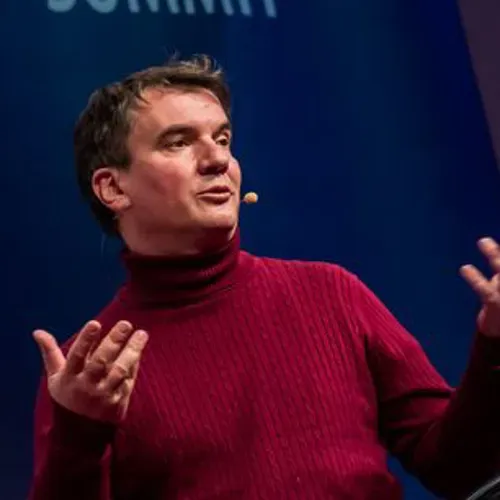
The organisers of the Human2Human Summit describe human connection as "the ultimate currency". It is easy to read that as a slogan. We think it is closer to an economic observation, and one that matters more as AI moves deeper into how we plan, sell and run live experiences.
The argument is simple. When something becomes abundant, its value falls. When something stays scarce while everything around it gets cheaper, its value rises. AI is making a great deal abundant: content, summaries, recommendations, personalised messages, even passable conversation. What it cannot manufacture is the experience of sharing a room with people who also chose to be there.
That is the bet at the heart of H2H. As the world becomes more digital, face-to-face experiences become more valuable, not less. Here is why we think the bet is sound.
Four reasons we think the room is gaining value
Scarcity
Time is the one budget AI does not expand. A senior leader can ask a model for a market briefing in seconds, but cannot ask it for a free afternoon. Every hour spent travelling to a venue and sitting at a table is an hour withheld from something else. That cost is exactly what gives the choice meaning. When attendance is a deliberate decision, the people in the room are signalling something to each other before a word is spoken.
Trust
Trust rests on evidence that is hard to fake. As generated text, images and voices become routine, the cost of faking a digital signal falls towards zero. A handshake, a conversation that drifts off-script, the way someone handles a difficult question: these remain expensive to counterfeit. For an industry built on partnerships between organisers, venues, suppliers and exhibitors, that matters. Deals still begin with someone deciding that the person opposite is worth backing.
Memory
Most of us remember places and people far better than we remember feeds. An idea heard in a ballroom, tested over coffee and argued again at a round table has three anchors: the setting, the voices and the disagreement. An idea read on a screen usually has one. If the purpose of a live experience is to change what people think and do afterwards, memory is not a side effect. It is the product.
Serendipity
Algorithms are very good at giving us more of what we already like. They are far weaker at introducing us to the person we did not know we needed to meet. A room of people from different sectors produces encounters no recommendation engine would plan. H2H is built on exactly this. Exhibition organisers, venues, visitor attractions, conference producers and event-technology companies rarely share a room, yet a theme-park operator and a trade-show organiser may have more in common than they think.
What we heard on the day
The 2026 summit in Dubai, held on 15 January, gave this argument texture. The day included exhibitor satisfaction data from 2017 to 2024, showing sentiment improving after COVID and in-person experience positioned as a premium product. That framing is worth sitting with. To us, premium does not simply mean expensive. It means chosen, for reasons a cheaper substitute cannot meet.
The programme also set out five principles for using AI in live experiences, summed up in one line: "AI cleans the path, humans walk it." We find the line a useful test in its own right. Our reading: AI earns its place when it removes the friction that keeps people apart, and loses it when it starts standing in for the encounter itself.
Another highlight was the growth story of ADIPEC, which grew into a show of 239,000 visitors by investing in content rather than margin. The lesson we draw is that people travel for substance, and for the others who come for it too.
What this asks of leaders
If connection is the currency, then designing a live experience is a question of how that currency is earned and spent. Some implications, offered as the community's perspective rather than a formula:
- Protect unstructured time. Coffee breaks and corridors are not dead space. They are where much of the value changes hands.
- Put AI behind the scenes first. Let it handle what bores people, so the people can focus on each other.
- Measure what matters. Footfall is easy to count. The conversations that led somewhere are harder to count, and more telling.
- Design for mixing. Seating, formats and hosting decide whether people meet strangers or stay with the colleagues they arrived with.
Three questions for members
- Where in your own events has AI given attendees more time with each other, and where has it quietly taken that time away?
- If in-person experience is a premium product, what exactly are your audiences paying for, and how do you know?
- What is the most valuable connection you have made at a live event, and could any digital channel have produced it?
Join the conversation
We would like to hear your answers, and your disagreements. Take these questions to peers through member connections, or see how members take part. For the full picture of the day, read the 2026 summit recap, or ask Amal, the community's AI assistant, anything about H2H. New here? Start with About the community, then browse more Insights.